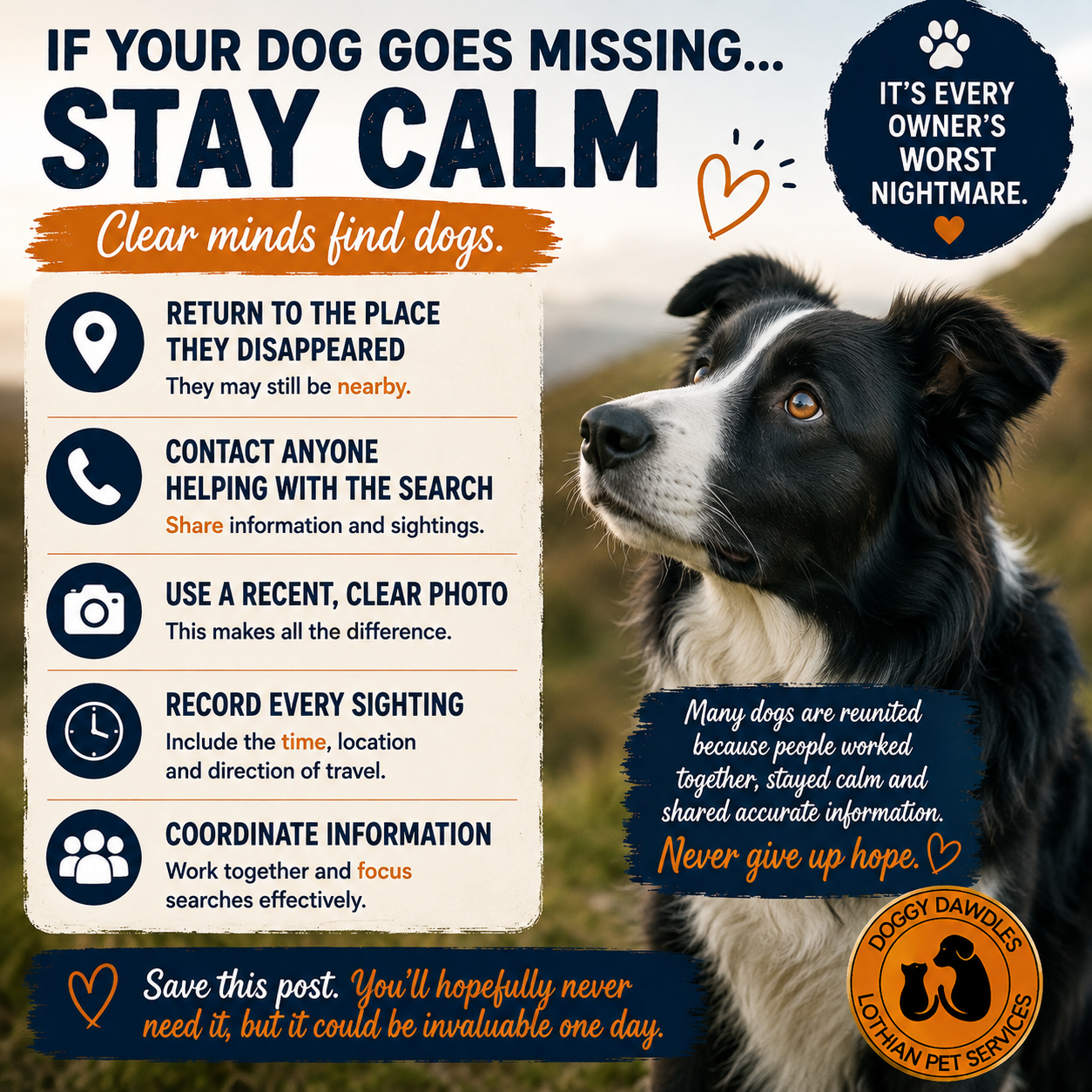
No owner ever expects their dog to go missing.
One moment you’re enjoying a walk, loading the car or opening the front door.
The next, your dog has disappeared from sight.
While not every escape can be prevented, many happen because of small oversights or situations that catch even experienced owners off guard.
The good news is that a few simple habits can significantly reduce the chances of your dog becoming lost.
This guide looks at practical ways to improve your dog’s safety at home, on walks and when travelling.
Dogs Don’t Usually “Run Away”
One of the biggest myths about missing dogs is that they simply decide to leave.
In reality, most dogs become lost because of a trigger.
Common examples include:
- A gate left open.
- A collar or harness slipping off.
- Fireworks or thunder (or other loud noise).
- Chasing wildlife.
- Becoming startled by another dog.
- Equipment failure (eg. a lead snapping).
- Road traffic collisions.
- Escaping from unfamiliar accommodation.
- Fear during veterinary visits.
Understanding what causes escapes is the first step in trying to prevent them.
Choose the Right Walking Equipment
Your dog’s equipment is their first line of defence.
Before every walk, check:
✔ Harness fits correctly.
✔ Collar isn’t too loose.
✔ ID tag is attached to collar/harness.
✔ Lead clips aren’t damaged. The lead itself doesn’t have any fraying or damage.
✔ Carabiners and swivel clips work properly.
Many trainers recommend using a well-fitted Y-front harness for dogs that may spook or back out of collars. There are other harnesses that can be better for the houdinis of the dog world.
For particularly nervous dogs, a double-ended lead attached to both a harness and collar can provide an extra layer of security.
Equipment should always be checked regularly for wear and tear.
Keep Identification Up to Date
By law in the UK, dogs must wear a collar with the owner’s name and address while in a public place (subject to certain exemptions), and they must also be microchipped with current contact details.
If you’ve moved house, changed your phone number or updated your emergency contact, make sure your dog’s records are updated too. We recommend that you check the details held on the database you are registered with at least once a year, as there have been increasing numbers of missing details(even after owners have updated them!).
An out-of-date microchip can delay a reunion by hours, or even days.
Secure Your Home and Garden
Many missing dogs never disappear from a walk.
Instead, they leave through:
- Garden gates.
- Damaged fencing.
- Open garage doors.
- Tradespeople leaving access points unsecured.
- Delivery drivers.
- Visitors unfamiliar with your dog’s habits.
Regularly walk around your garden and property looking for gaps, loose panels or anything your dog could squeeze through or climb over.
If you know you’re expecting visitors, consider using baby gates, closed internal doors or keeping your dog on a lead until everyone has arrived. You could also consider training a “settle” or “place” cue or boundary control, so they know what is expected of them when the door opens.
Think Ahead on Walks
Even dogs with excellent recall can have off days.
Before unclipping the lead, ask yourself:
- Is this area secure?
- What distractions are nearby?
- Could there be livestock or wildlife?
- Are there roads close by?
- Has my dog shown signs of stress today?
- Is my dog’s recall reliable in this environment?
Choosing to keep your dog on lead isn’t a failure, it’s responsible management.
Prepare for High-Risk Situations
Certain events increase the likelihood of dogs escaping.
These include:
⛈ Thunderstorms
🚚 House moves
🏕 Holidays
🏥 Veterinary visits
🏡 New rescue dogs settling into a home
During these times, extra precautions such as double-checking doors, using secure harnesses and avoiding unnecessary off-lead exercise can make a huge difference.
Train for Safety, Not Perfection
Training is important, but even the best-trained dogs can panic.
Rather than expecting perfection, focus on building skills that improve safety:
- Reliable recall.
- Emergency stop cues.
- Positive lead walking.
- Confidence around new environments.
- Calmness when startled.
These behaviours should be practised regularly using reward-based methods.
Remember that training supports safety, it cannot eliminate every risk.
Travel Safely
Many dogs go missing while travelling.
Simple precautions include:
- Attach the lead before opening the car door.
- Secure dogs with a crash-tested harness or crate.
- Check unfamiliar accommodation before letting your dog explore.
- Avoid removing leads in unfamiliar places until your dog has settled.
A few extra seconds of preparation can prevent a frightening situation.
If the Worst Happens
Even with careful planning, accidents can happen.
If your dog does go missing:
- Stay as calm as possible.
- Return to the last known location.
- Gather accurate sightings.
- Contact the relevant organisations promptly.
- Ask people not to chase your dog.
Knowing what to do beforehand means you are less likely to panic if the unexpected happens.
UK Guidance
- Dogs in public places (with limited exemptions) must wear a collar displaying the owner’s name and address under the Control of Dogs Order 1992.
- Since April 2016, all dogs in England, Scotland and Wales must be microchipped, and owners are responsible for keeping their contact details up to date.
- While these legal requirements improve the chances of a reunion, good equipment, training and management remain the best way to prevent a dog from going missing in the first place.
Frequently Asked Questions
For many dogs, yes. Particularly those prone to backing out of collars or becoming startled. A well-fitted harness distributes pressure more evenly and can offer better security, though the right choice depends on the individual dog and activity.
Yes. Dogs in public places (with limited exemptions) must wear a collar displaying the owner’s name and address under the Control of Dogs Order 1992.
Good recall greatly reduces risk, but fear can temporarily override even well-trained behaviours. Management and suitable equipment remain essential.
Every dog has a first unexpected event. Taking sensible precautions protects both your dog and your peace of mind.
Yes. Since April 2016, all dogs in England, Scotland and Wales must be microchipped, and owners are responsible for keeping their contact details up to date.
Key Takeaways
✔ Most dogs become lost because of an unexpected trigger.
✔ Well-fitted equipment and up-to-date identification are essential.
✔ Check your home and garden regularly for escape risks.
✔ Consider your surroundings before letting your dog off lead.
✔ Training is important, but management is just as valuable.
✔ Preparation is the best way to reduce the risk of a missing dog.
Final Thoughts
None of us likes to imagine our dog going missing.
Fortunately, preventing many escapes comes down to building small safety habits into everyday life.
Checking a harness, closing a gate, updating a microchip or choosing to keep your dog on lead for one walk might seem insignificant at the time.
Yet those simple decisions could prevent one of the most distressing experiences a dog owner can face.
Responsible ownership isn’t about expecting the worst.
It’s about being prepared for the unexpected.
About Doggy Dawdles
At Doggy Dawdles, I provide professional dog walking, pet sitting, dog training and Wedding Dog Chaperone services across East Lothian and the surrounding areas. My approach is simple: every dog is an individual, and their welfare always comes first.
If you’d like to find out more about any of my services, or simply have a question about your dog’s care, I’d love to hear from you.
Because professional pet care is about much more than just walking dogs.
Suggested Internal Links
Cornerstone: What to Do When You See a Loose or Lost Dog: A Practical Guide for the Public
Supporting Articles
- Understanding Flight Mode: Why Frightened Dogs Run Instead of Coming to You
- My Dog Has Gone Missing
- Breed Specific Legislation, Dog Bite Risk and Responsible Ownership: What the Evidence Really Says
References
American Veterinary Society of Animal Behavior (AVSAB) (2021). Position Statements and Resources.
British Small Animal Veterinary Association (BSAVA) (2022). BSAVA Manual of Canine and Feline Behavioural Medicine.
Overall, K.L. (2013). Manual of Clinical Behavioral Medicine for Dogs and Cats. Elsevier.
Rooney, N.J. & Cowan, S. (2011). ‘Training methods and dog welfare’, Journal of Veterinary Behavior, 6(4), pp. 213–221.
Yin, S. (2009). Low Stress Handling, Restraint and Behaviour Modification of Dogs & Cats.
Sign up for Newsletters which include relevant doggy info and important updates from Doggy Dawdles.
No responses yet