One of the hardest things for owners to understand is why their dog doesn’t come back when they are called.
It’s a question that’s often asked when a dog goes missing:
“They’ve always had brilliant recall. Why are they ignoring me now?”
The simple answer is: they probably aren’t.
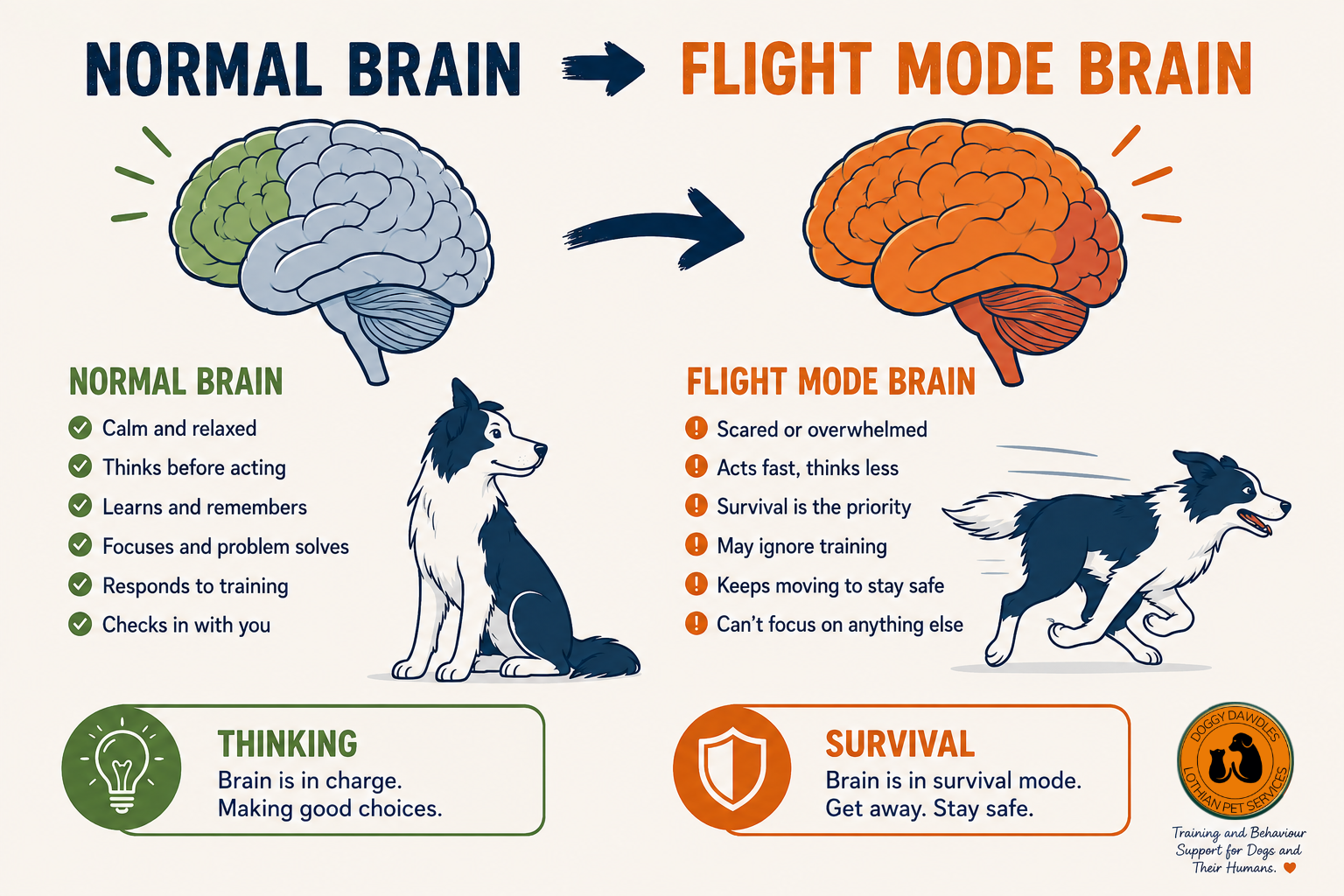
When dogs experience intense fear, their brain changes how it processes the world around them. Decisions become focused on survival rather than social interaction, obedience or even recognising familiar people.
This survival response is commonly referred to as flight mode, and understanding it is one of the most important steps in helping lost dogs return home safely.
what to do if you see a loose dog
What Is Flight Mode?
Flight mode is part of the body’s natural survival system.
When a dog perceives danger, the brain rapidly decides whether the safest option is to:
- Fight
- Flight (flee)
- Freeze
These responses happen automatically. The dog isn’t making a conscious decision. They’re responding exactly as nature designed them to.
Thousands of years of evolution have created a nervous system that reacts incredibly quickly to anything perceived as threatening.
For many dogs, especially those with an easy escape route, that response is simply to run.
What Happens Inside the Brain?
When fear is triggered, the brain activates the sympathetic nervous system. Stress hormones such as adrenaline begin circulating through the body.
Heart rate increases.
Breathing becomes faster.
Muscles receive more oxygen.
The senses become highly alert.
These changes prepare the body for one thing: Survival.
During this process, the parts of the brain involved in thoughtful decision-making become much less influential.
That’s why frightened dogs often seem completely different from their normal selves.
Why Recall Often Fails
Owners sometimes worry they’ve done something wrong because their dog ignores them.
In reality, even dogs with excellent training may fail to respond during extreme fear.
Imagine trying to solve a puzzle while escaping from a fire. Your brain wouldn’t prioritise the puzzle.
The same principle applies to dogs.
Instead of thinking: “That’s my owner calling.”
The brain is thinking: “Keep moving. Stay safe.”
Training hasn’t disappeared. It’s simply being overridden by survival instincts.
Why Dogs Keep Running
People often expect a frightened dog to stop once they’ve escaped the immediate situation.
Unfortunately, that’s not always what happens. Several factors encourage continued movement:
Adrenaline: The body is already primed for running. The dog may continue travelling long after the original trigger has disappeared.
New Scary Experiences: As the dog runs, they may encounter:
- Traffic
- Strangers
- Cyclists
- Other dogs
- Loud noises
Each new experience reinforces the belief that continuing to move is the safest option.
Being Chased: This is one of the biggest reasons dogs continue travelling. Every person who runs towards them confirms that something is following them. Even well-meaning attempts to help can unintentionally keep the dog moving.
Every Dog Responds Differently: Not every loose dog behaves the same way.
Some will:
- Continue running for miles.
- Hide quietly in dense vegetation.
- Extremely cautious around people.
- Approach one calm individual while avoiding everyone else.
Age, previous experiences, temperament, genetics, health and environment all influence how each dog responds.
There is no single “lost dog behaviour.”
Fear Changes Behaviour
Many owners describe their missing dog as:
“He wouldn’t hurt a fly.”
“She loves everyone.”
“He always comes back.”
These things can all be true, BUT Fear temporarily changes behaviour.
A sociable dog may suddenly avoid people.
A confident dog may become withdrawn.
A food motivated dog may ignore treats.
None of these changes mean the dog’s personality has disappeared.
They’re temporary responses to overwhelming stress.
How People Can Help
Understanding flight mode changes how we should respond.
Instead of trying to catch the dog immediately:
✔ Stay calm.
✔ Avoid chasing.
✔ Observe quietly.
✔ Record useful information.
✔ Report accurate sightings.
Often, reducing pressure gives frightened dogs the confidence to slow down, rest, and eventually recover more easily.
What Owners Should Remember
If your dog has gone missing:
Please don’t:
- assume they don’t recognise you.
- don’t think your training has failed.
- don’t blame yourself because they kept running.
Your dog is frightened.
They’re responding instinctively rather than emotionally.
Many dogs are successfully reunited with their families once they feel safe enough for survival mode to begin switching off.
Patience is often one of the most valuable tools during recovery.
Frequently Asked Questions
Yes.
Strong emotions such as fear can temporarily override learned behaviours, even in well-trained dogs.
No.
Some dogs freeze, hide or seek people instead.
Every dog is an individual.
Almost certainly.
Recognition isn’t usually the problem. Responding is.
Fear changes priorities.
In most situations, no.
Chasing often increases movement and makes recovery more difficult.
Always consider the dog’s emotional state and the surrounding environment before attempting to intervene.
Key Takeaways
✔ Flight mode is a normal survival response.
✔ Fear changes how dogs process information.
✔ Even excellent recall may temporarily disappear.
✔ Chasing usually reinforces running.
✔ Calm observations often help more than active pursuit.
✔ Understanding behaviour improves the chances of a safe reunion.
Final Thoughts
Watching a frightened dog run away is incredibly difficult.
Our instinct is to act quickly, close the distance and bring them to safety.
Yet canine behaviour tells us that calm, informed decisions are often far more effective than fast reactions.
By understanding flight mode, we stop seeing a dog that’s “ignoring” people and start recognising a dog that’s simply trying to survive.
That shift in perspective changes everything.
The calmer we remain, the more space we give, and the more accurately we share information, the greater the chance that frightened dog will eventually find their way home.
About Doggy Dawdles
At Doggy Dawdles, I provide professional dog walking, pet sitting, dog training and Wedding Dog Chaperone services across East Lothian and the surrounding areas. My approach is simple: every dog is an individual, and their welfare always comes first.
If you’d like to find out more about any of my services, or simply have a question about your dog’s care, I’d love to hear from you.
Because professional pet care is about much more than just walking dogs.
Suggested Internal Links
- What to Do When You See a Loose or Lost Dog: A Practical Guide for the Public
- Helping Prevent Lost Dogs: Practical Steps Every Owner Should Take
- Breed Specific Legislation, Dog Bite Risk and Responsible Ownership: What the Evidence Really Says
References
American Veterinary Society of Animal Behavior (AVSAB) (2021). Position Statements and Resources.
Horwitz, D. & Mills, D. (2022). BSAVA Manual of Canine and Feline Behavioural Medicine. BSAVA.
Overall, K.L. (2013). Manual of Clinical Behavioral Medicine for Dogs and Cats. Elsevier.
Rooney, N.J. & Cowan, S. (2011). ‘Training methods and dog welfare’, Journal of Veterinary Behavior, 6(4), pp. 213–221.
Yin, S. (2009). Low Stress Handling, Restraint and Behaviour Modification of Dogs & Cats.
Sign up for Newsletters which include relevant doggy info and important updates from Doggy Dawdles.
No responses yet