Imagine you’re out for a walk when you spot a dog running loose.
Perhaps they’re wandering along a country lane.
Maybe they’re trotting through a park.
Or perhaps they’re running across a busy road.
Your first instinct is probably to help.
That’s exactly what most people do.
Unfortunately, some of the most common ways people try to help can actually make the situation far more dangerous.
Understanding what a frightened dog needs and what they don’t can make all the difference.
This guide explains how you can help safely, calmly and effectively.
First Things First: Is the Dog Really Lost?
Not every loose dog has escaped.
Some dogs may be:
- Walking just ahead of their owner.
- Exercising off lead.
- Working dogs carrying out a task.
Before intervening, take a few moments to observe.
Ask yourself:
- Does the dog look relaxed?
- Are they looking back towards someone?
- Is an owner nearby?
- Do they appear frightened or purposeful?
If the dog is clearly distressed, injured or in immediate danger, then action is needed.
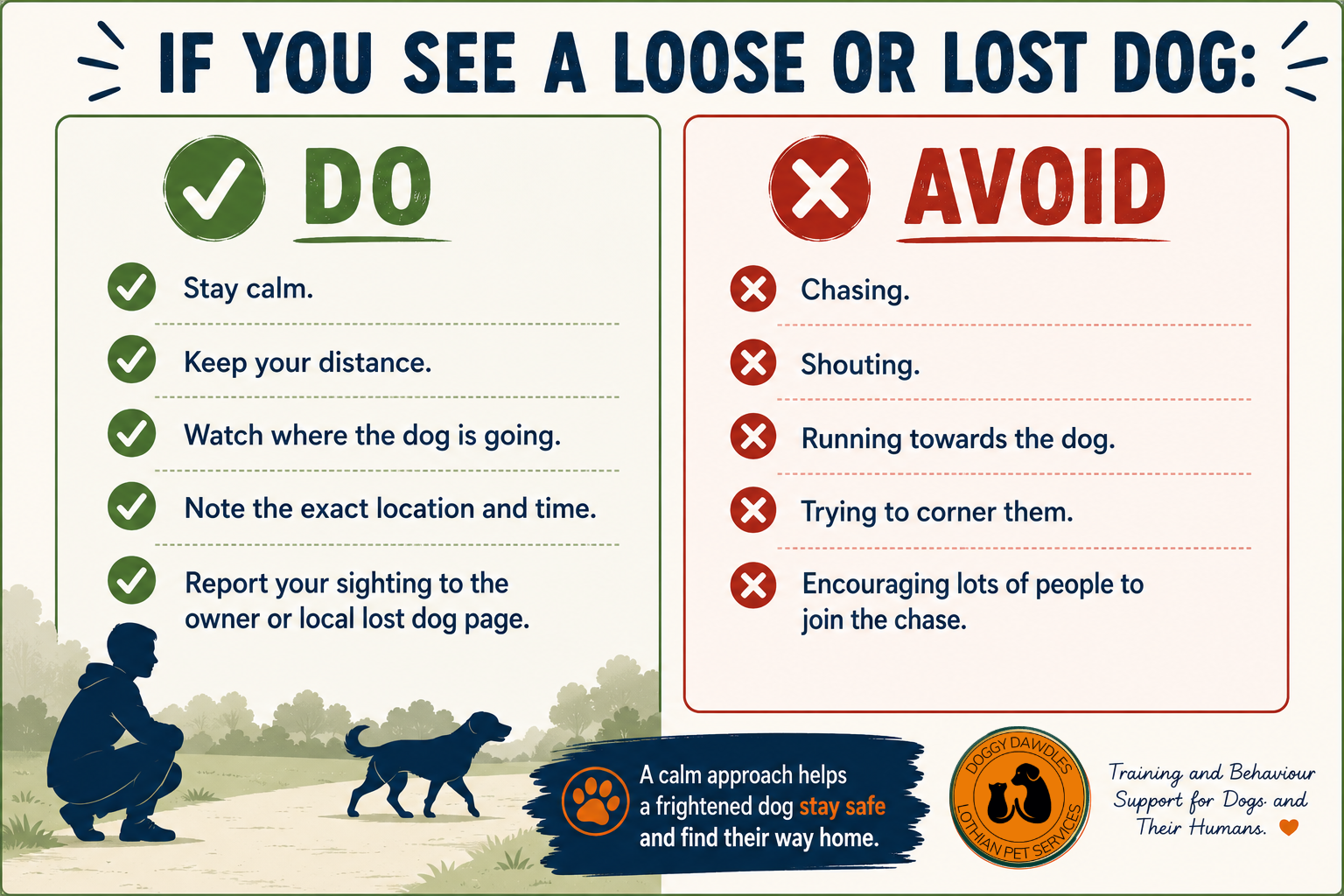
DO: Stay Calm
Dogs read body language incredibly well.
Running, waving your arms or shouting can appear threatening, especially to an already frightened dog.
Instead:
✔ Stand still.
✔ Keep your movements slow.
✔ Speak quietly if necessary.
✔ Allow the dog to notice you rather than approaching them immediately.
Sometimes simply becoming a calm presence is enough to stop the dog feeling additional pressure.
DON’T: Chase the Dog
This is probably the biggest mistake people make.
Chasing often:
- Reinforces flight behaviour.
- Pushes the dog further from home.
- Increases stress.
- Encourages dangerous road crossings.
- Makes recovery significantly harder.
Remember:
The goal isn’t to catch the dog yourself.
The goal is to help them get home safely.
DO: Observe Carefully
Some of the most valuable information you can provide includes:
📍 Exact location.
🕒 Time.
➡️ Direction of travel.
🐕 Description of the dog.
🎽 Collar, harness or lead.
👀 Behaviour.
These details help owners and search volunteers understand the dog’s movements and identify patterns.
DON’T: Surround the Dog
Well-meaning groups often spread out to stop a dog escaping.
Unfortunately, from the dog’s perspective, they’ve just lost every safe exit.
Feeling trapped can cause them to:
- Bolt.
- Hide.
- Become defensive.
- Cross roads unexpectedly.
Always leave the dog an obvious escape route.
Ironically, giving them space often helps them settle more quickly.
DO: Report Accurate Sightings
Accuracy is everything.
Instead of saying:
“I saw the dog near the woods.”
Try:
“3:20 pm. South side of the John Muir Way near the old railway bridge. Running east towards Longniddry. Blue harness still attached.”
This information is incredibly useful.
DON’T: Share Old Information Without Saying When It Was Seen
One of the biggest challenges during searches is outdated sightings.
A post saying:
“I saw the dog near the golf course.”
isn’t particularly useful if it happened four hours ago.
Always include:
- Date.
- Time.
- Exact location.
This prevents search teams wasting valuable time.
DO: Let the Dog Make the Choice
If the dog slows down or appears interested:
Turn slightly sideways.
Avoid direct eye contact.
Remain quiet.
If you have food available, you may gently place some on the ground and step back.
Allow the dog to decide whether to approach.
Never force interaction.
DON’T: Grab Suddenly
Even friendly dogs may panic if someone suddenly reaches for them.
A frightened dog may:
- Jump away.
- Run.
- Bite defensively.
If the dog chooses to approach, move slowly and calmly.
Trainer’s Insight
One calm, accurate sighting is often more valuable than twenty people trying to catch a frightened dog. Lost dogs are rarely recovered because someone ran faster than they did, they’re recovered because people stayed calm, shared accurate information and understood how fear influences behaviour.
What If the Dog Is Injured?
An injured dog may behave very differently.
Pain can make even gentle dogs react unpredictably.
If the dog appears injured:
- Do not put yourself at risk.
- Contact the owner if known.
- Contact a local dog warden, rescue organisation or veterinary practice for advice.
Only intervene if it is safe to do so.
Helping the Owner
Remember that someone is probably desperately searching for their dog.
The best way to support them is by providing:
✔ Accurate information.
✔ Honest observations.
✔ Current locations.
✔ Calm reassurance.
Avoid speculation or criticism.
Owners are often frightened, exhausted and overwhelmed.
Kindness matters.
Frequently Asked Questions
Only if they appear relaxed and willing to engage.
Repeated shouting usually increases pressure.
Yes, if it’s safe and you can do so without approaching the dog.
Allow them to make the choice.
Move slowly.
Check for an ID tag.
Contact the owner if possible.
If there is no identification, contact the appropriate local authority, veterinary practice or rescue organisation for advice.
Don’t chase.
Watch where they go and report the sighting.
That information is often more valuable than continuing the pursuit.
Key Takeaways
✔ Stay calm.
✔ Don’t chase.
✔ Give the dog space.
✔ Observe carefully.
✔ Report accurate sightings.
✔ Let the dog choose whether to approach.
✔ Every calm action improves the chances of a safe reunion.
Final Thoughts
Helping a loose dog isn’t about being the first person to catch them.
It’s about making thoughtful decisions that reduce fear rather than increase it.
Sometimes the most valuable thing you can do is simply watch, record and report.
Those few moments of patience could be exactly what helps a frightened dog find their way back to the people who love them.
Helping doesn’t always mean getting closer.
Sometimes helping means giving them the space they need.
About Doggy Dawdles
At Doggy Dawdles, I provide professional dog walking, pet sitting, dog training and Wedding Dog Chaperone services across East Lothian and the surrounding areas. My approach is simple: every dog is an individual, and their welfare always comes first.
If you’d like to find out more about any of my services, or simply have a question about your dog’s care, I’d love to hear from you.
Because professional pet care is about much more than just walking dogs.
Suggested Internal Links
- What to Do When You See a Loose or Lost Dog: A Practical Guide for the Public
- Understanding Flight Mode: Why Frightened Dogs Run Instead of Coming to You
- Helping Prevent Lost Dogs: Practical Steps Every Owner Should Take
References (Harvard Style)
American Veterinary Society of Animal Behavior (AVSAB) (2021). Position Statements and Resources.
Horwitz, D. & Mills, D. (2022). BSAVA Manual of Canine and Feline Behavioural Medicine. BSAVA.
Overall, K.L. (2013). Manual of Clinical Behavioral Medicine for Dogs and Cats. Elsevier.
Rooney, N.J. & Cowan, S. (2011). ‘Training methods and dog welfare’, Journal of Veterinary Behavior, 6(4), pp. 213–221.
Yin, S. (2009). Low Stress Handling, Restraint and Behaviour Modification of Dogs & Cats.
Sign up for Newsletters which include relevant doggy info and important updates from Doggy Dawdles.
No responses yet