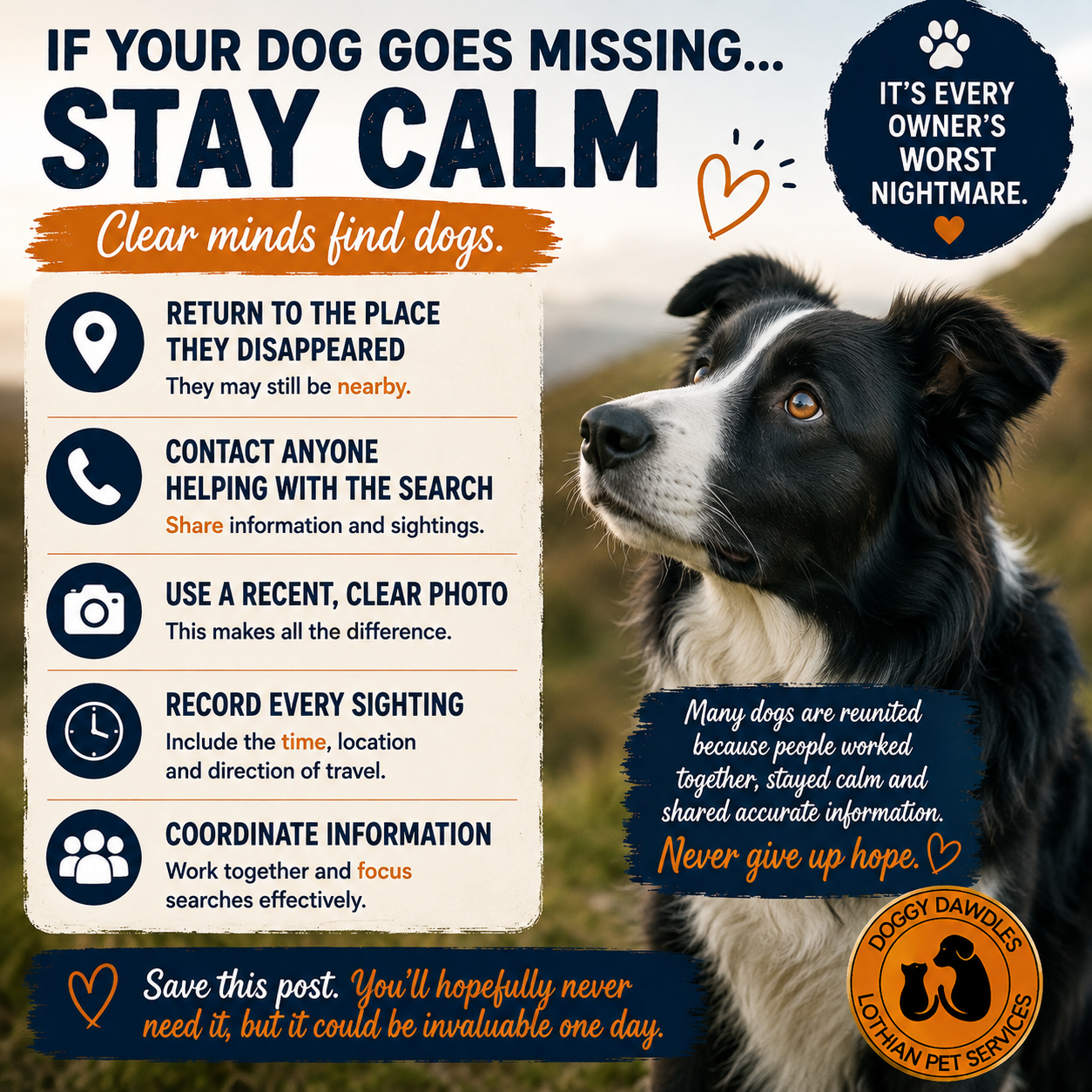
Few things are more frightening than turning around and realising your dog is no longer beside you.
Whether they slipped their harness, bolted after wildlife, became startled by a loud noise or escaped through an open gate, those first few moments can feel overwhelming. Your heart races, your mind fills with worst-case scenarios and it’s easy to panic.
While every situation is different, your actions in the first few minutes and hours can have a significant impact on the outcome.
This guide will help you stay calm, avoid common mistakes and give your dog the best possible chance of returning home safely.
Take a Breath Before You Take Action
It’s completely natural to panic.
However, panic often leads to rushed decisions that can make recovery more difficult.
Instead, stop for a moment.
Think about:
- Where was your dog last seen?
- What frightened them?
- Which direction did they run?
- Did anyone else see what happened?
A calm, organised approach is usually far more effective than reacting impulsively.
Trainer’s Insight
Your dog isn’t running away from you, they’re running from whatever frightened them. Understanding that difference changes how you should respond.
Return to the Last Known Location
Many dogs remain surprisingly close to where they first became separated from their owner.
Return to the exact location where your dog was last seen and remain there for a while if it is safe to do so.
Your dog may:
- Circle back.
- Return once the frightening stimulus has gone.
- Follow their own scent trail.
If several people are helping, avoid everyone searching in different directions immediately. A coordinated approach is far more effective.
Don’t Turn It Into a Chase
One of the biggest mistakes owners make is running after their dog.
If your dog is frightened and has entered flight mode, chasing often reinforces their instinct to keep running.
Instead:
- Stay calm.
- Avoid shouting repeatedly.
- Give your dog space.
- Watch where they go if they remain in sight.
Understanding flight mode can help explain why frightened dogs don’t always respond to recall, even if they normally have excellent training.
Start a Sighting Log
As soon as possible, begin recording every piece of information.
Useful details include:
- Time.
- Exact location.
- Direction of travel.
- Behaviour.
- Who reported the sighting.
- Contact details if appropriate.
Patterns often emerge over time, helping you and anyone assisting to focus search efforts more effectively.
Contact the Right People
Once you’ve gathered the initial information, begin contacting the people and organisations who can help.
Depending on your location, this may include:
- Family and friends.
- Local lost dog Facebook groups.
- Nearby veterinary practices.
- Local authority dog wardens.
- Animal rescue organisations.
- Local dog walkers and pet professionals.
Provide clear, factual information and keep updates current.
Create a Clear Missing Dog Post
A good missing dog post should include:
- A recent photograph.
- Your dog’s name.
- Breed or description.
- Collar, harness or lead details.
- Last known location.
- Date and time last seen.
- Contact number.
Avoid long paragraphs or emotional language that may make key information difficult to find quickly.
Use Social Media Wisely
Social media can be an incredibly powerful tool when used effectively.
Ask people to report sightings rather than chase your dog.
Encourage anyone who sees your dog to include:
- Exact location.
- Time.
- Direction of travel.
- Behaviour.
This information is often far more valuable than dozens of people searching randomly.
When Someone Reports a Sighting
It can be tempting to drive straight to every reported location.
Instead:
- Confirm when the sighting occurred.
- Check whether multiple sightings suggest a pattern.
- Coordinate your response rather than reacting to each report individually.
Remember, your dog may have moved significantly since an earlier sighting.
If Your Dog Comes Into View
If you’re fortunate enough to see your dog:
Stay calm.
Avoid running towards them.
Turn slightly sideways.
Speak softly.
Allow your dog to make the decision to approach you.
Many frightened dogs need reassurance rather than pressure.
After Your Dog Is Home
Finding your dog is an enormous relief, but it’s also worth taking time to understand why they went missing.
Ask yourself:
- Did equipment fail?
- Was something frightening them?
- Was the environment too challenging?
- Is there training or management that could reduce the risk in future?
Learning from the experience can help prevent it from happening again.
Frequently Asked Questions
Use your judgement. Calmly calling your dog may help if they are nearby and receptive, but repeated shouting can increase stress and confusion.
Not immediately. Large groups moving through an area may unintentionally push a frightened dog further away. Coordinate your search and focus on gathering accurate sightings.
Fear can temporarily override learned behaviours. This is a normal survival response and does not mean your training has failed.
In some situations, familiar scents may encourage a dog to remain in or return to an area. Consider your local environment and seek advice from experienced recovery organisations if appropriate.
Key Takeaways
✔ Stay as calm as possible.
✔ Return to the last known location.
✔ Avoid chasing.
✔ Record accurate sightings.
✔ Coordinate your search.
✔ Understand how fear changes behaviour.
✔ Learn from the experience once your dog is safely home.
Final Thoughts
Losing a dog is an emotional experience that no owner wants to face.
While it’s impossible to remove every risk, understanding canine behaviour and responding calmly can make a significant difference.
Your dog hasn’t forgotten you.
They’re not being disobedient.
They’re frightened.
By staying patient, gathering accurate information and allowing your dog’s behaviour to guide your next steps, you give them the best possible chance of finding their way home.
UK Guidance
If your dog goes missing:
- Ensure your dog’s microchip provider is informed as soon as possible so your dog’s record can be flagged as missing.
- If your dog is recovered by a veterinary practice or local authority, an up-to-date microchip greatly increases the chance of a quick reunion.
- If your contact details change, update your microchip record promptly. A microchip is only as useful as the information attached to it.
About Doggy Dawdles
At Doggy Dawdles, I provide professional dog walking, pet sitting, dog training and Wedding Dog Chaperone services across East Lothian and the surrounding areas. My approach is simple: every dog is an individual, and their welfare always comes first.
If you’d like to find out more about any of my services, or simply have a question about your dog’s care, I’d love to hear from you.
Because professional pet care is about much more than just walking dogs.
References
American Veterinary Society of Animal Behavior (AVSAB) (2021). Position Statements and Resources.
Horwitz, D. & Mills, D. (2022). BSAVA Manual of Canine and Feline Behavioural Medicine. BSAVA.
Overall, K.L. (2013). Manual of Clinical Behavioral Medicine for Dogs and Cats. Elsevier.
Rooney, N.J. & Cowan, S. (2011). ‘Training methods and dog welfare’, Journal of Veterinary Behavior, 6(4), pp. 213–221.
Yin, S. (2009). Low Stress Handling, Restraint and Behaviour Modification of Dogs & Cats.
Sign up for Newsletters which include relevant doggy info and important updates from Doggy Dawdles.
No responses yet